
Where Paper Still Breathes — A Personal Encounter with Handmade Time
There is something deeply human about paper. Not the kind that arrives in stacks, identical and silent, but paper that carries irregularity; paper that remembers the hands that created it. My interest in calligraphy has always drawn me toward the surface itself, not just the ink that rests on it. Because calligraphy is not only writing. It is a dialogue between movement, texture, and time.
In Ohrid, I encountered something that felt less like a craft and more like a preserved memory. The tradition of papermaking here dates back to the 16th century, when a Macedonian priest brought the knowledge from Venice, then one of Europe’s major printing centers. The process itself is far older, rooted in ancient methods that use the natural fibers from the core of trees, allowing the fibers to bind naturally without chemicals.
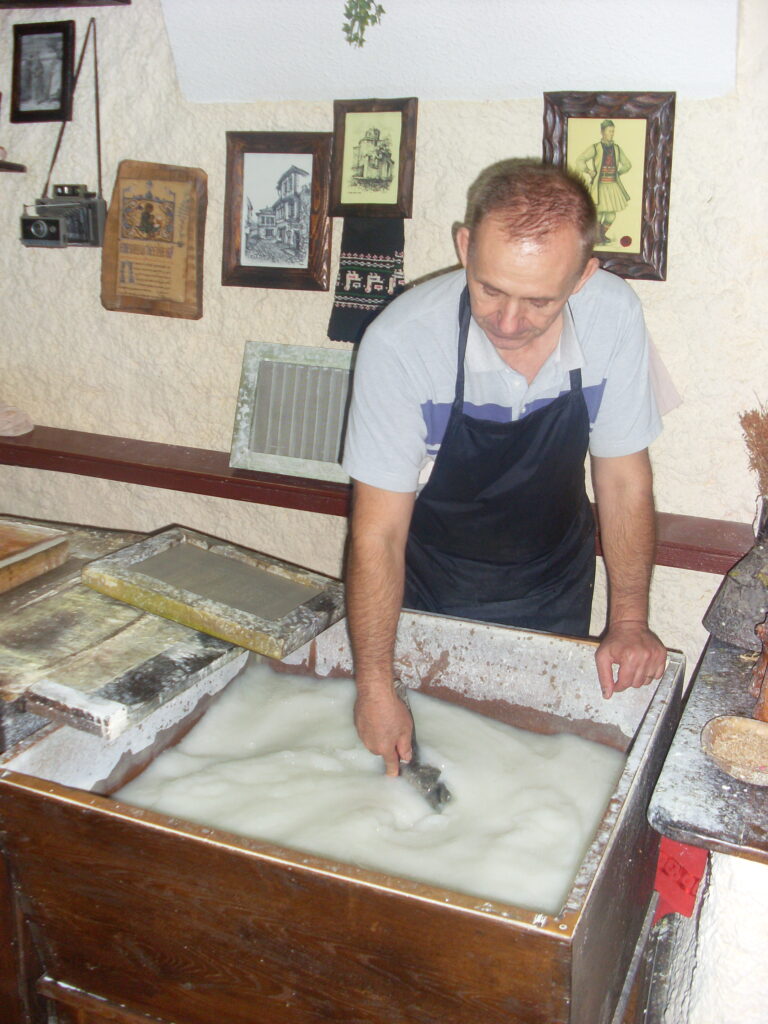
Watching this process unfold changes your perception of paper entirely. It takes nearly a month to produce a single sheet, with most of that time spent waiting for the fibers to form their natural bond. The sheet that emerges is not uniform. It breathes. It carries imperfection as identity.
What fascinated me even more was the presence of the Gutenberg press, an authentic reconstruction of the original printing mechanism that once gave form to the first printed books. It operates on the same principle, preserving a physical relationship between pressure, ink, and material.
I purchased something there that felt personal beyond its physical form: a portrait of Atatürk, printed on handmade paper using this traditional press. Holding it, I could feel the fibers beneath my fingers. It was not just an image. It was a convergence of histories; the history of writing, the history of printing, and the history of the person represented. The portrait did not feel reproduced. It felt created.
As someone deeply interested in calligraphy, this experience reshaped my understanding of the surface itself. Ink behaves differently on handmade paper. It does not sit on top, it enters the material, becoming part of it. The paper resists slightly, guiding the hand, forcing intention. Writing becomes slower. More deliberate. More honest.
In a world where everything accelerates toward efficiency, handmade paper remains an act of patience. It requires time, physical labor, and attention to natural processes. Nothing is automated. Nothing is rushed. It exists outside modern urgency.
I realized then that paper is not just a medium. It is a threshold. It connects the hand to permanence. It carries memory forward.
My Atatürk portrait now rests quietly in my collection. But it is more than an object. It is a reminder that creation once required time, and that perhaps the most meaningful things still do.
Tell us about your thoughtsWrite message